
My parents’ insurer accused them of fraud. I used AI to help fight the case.
On this page
65 documents, a cancelled health policy, and a binding award for ₹8.84 lakh. How I used Claude Code, ChatGPT Deep Research, Codex, and Slate to organise the evidence and help my parents challenge their insurer.
In February 2026, my 75-year-old father was hospitalised after recurrent fainting episodes and came home with a pacemaker. Six weeks later, he needed a triple bypass. The two hospitalisations generated bills of about ₹12 lakh. Another insurer reimbursed part of those costs; our dispute with Niva Bupa concerned the balance.
Then came the insurance dispute.
Niva Bupa declined cashless approval two days before the bypass, saying further verification was needed. We paid the hospital directly. In May, it cancelled my mother’s policy, under which my father was insured, alleging that his cardiac history had been concealed. It rejected the pacemaker claim under the policy’s fraud clause and subsequently denied the bypass claim too.
Meanwhile, its systems kept sending renewal reminders for the policy it had cancelled.
The fraud allegation was what made this especially distressing. We were trying to help my father recover from two major procedures. Now we also had to defend my parents’ honesty and fight to restore their health cover.
On 28 August, the Insurance Ombudsman in Bengaluru ordered Niva Bupa to pay ₹8,84,204 and reinstate the cancelled policy. The award is binding on the insurer.
We handled the complaint without a lawyer. I used AI throughout: to organise the documents, investigate questions, connect evidence, draft submissions, and prepare for the hearing. I also caught an AI summary that could have weakened our case.
This is how that process worked, including the handwritten medical note that became central to the outcome.
A question mark that disappeared
The dispute reached back to September 2024, when my father had experienced giddiness and low blood pressure following a stomach bug. His doctors attributed the episode to dehydration. His neurologist ordered a 24-hour Holter, a portable ECG recording.
The report contained findings that needed clinical interpretation. Doctors who reviewed it subsequently recorded it as within normal limits.
Another consultation note included “?PVD”, a query about peripheral vascular disease. In the insurer’s cancellation letter, that became “known case of PVD.” The question mark had disappeared. A possible diagnosis in a medical note was being presented as an established condition.
When my parents bought the policy in June 2025, they disclosed diabetes and hypertension. Our position was that the earlier consultations had not established the cardiac disease the insurer now said they had concealed. We needed to support that position with the medical records and the exact questions asked in the proposal form.
The insurer had the old Holter report because we had supplied it ourselves with the claim papers.
Each of these points needed evidence. Being certain that my parents had acted honestly was the starting point; presenting a clear, documented case was the work ahead.
Turning an archive into a case file
The material was scattered across email correspondence, roughly 65 PDFs, and my father’s physical outpatient notebook. There were policy documents, discharge summaries, test reports, denial letters, receipts, and scans with filenames such as Adobe Scan 30 May (7).pdf.
I needed to answer questions that crossed all of them. What had the insurer asked before issuing the policy? What had we disclosed? What had the doctors actually written? Which clause was being invoked, and what did the rest of that clause say?
Claude Code helped make the archive usable. It wrote scripts to convert a Gmail export into searchable, dated text and helped classify and rename the scanned documents. This brought out details I had missed in the correspondence: renewal reminders sent after cancellation, and a grievance response referring to a claim ID that was not ours.
It also helped draft the complaint annexure, written submissions, hearing notes, and follow-up emails.
The most useful working document was a file called CASE_STATUS.md. It held the chronology, arguments, supporting sources, corrections, and open tasks. After a break or a change of AI session, I could return to the current state of the case without reconstructing it from chat history.
That mattered over several months. A useful finding had somewhere to live, and a corrected mistake did too.
Reading the documents together
I’m the maker of Slate, an AI workspace for working with evolving project knowledge. This case became one of my most demanding uses of it.
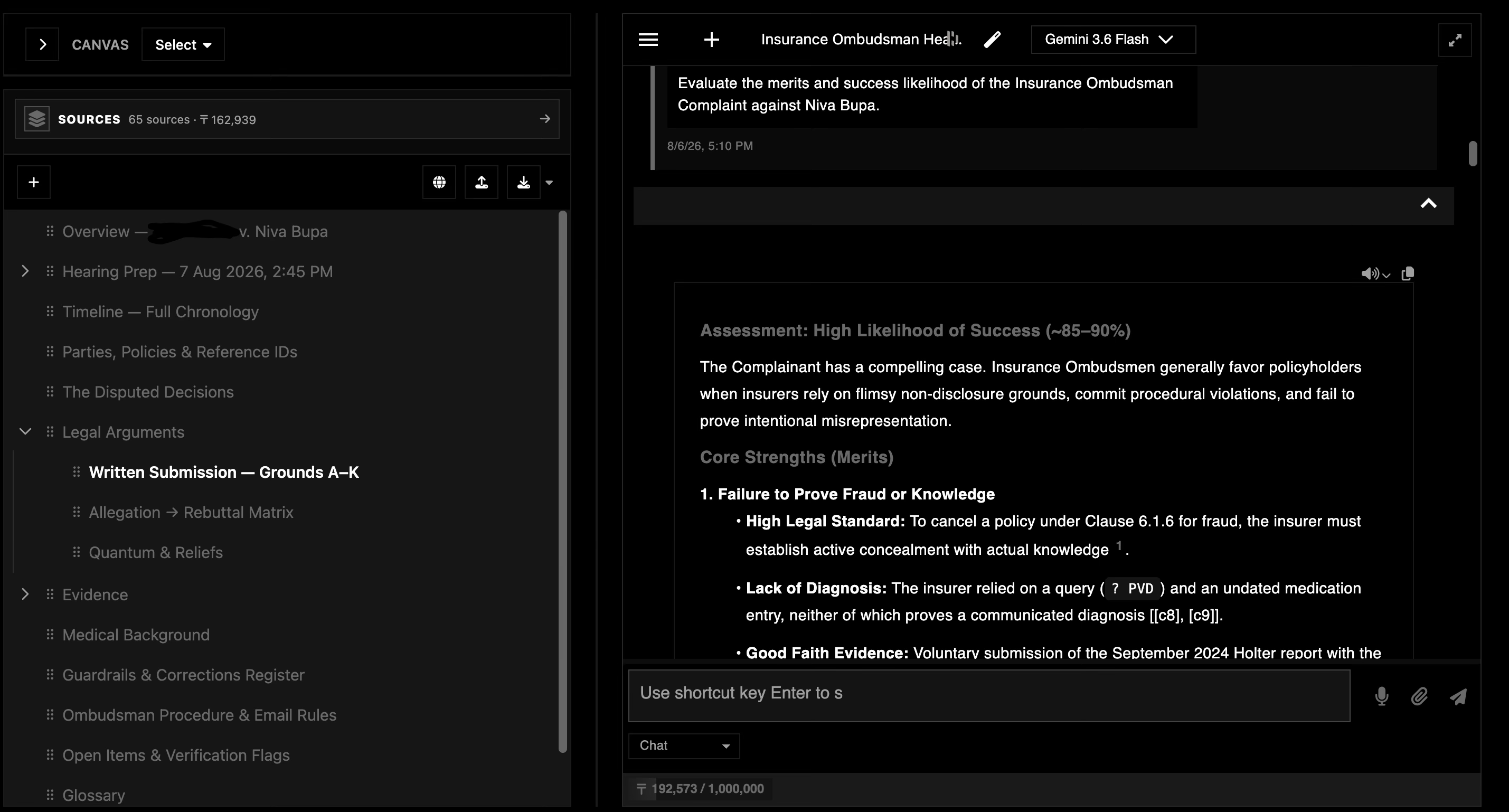
For this project, I used Slate’s full-context workflow to put all 65 documents into a single model context. The material totalled about 163,000 tokens, the units AI models use to process text. That let me ask questions with the policy wording, medical records, proposal form, and correspondence available together.
This was useful because I did not always know which document contained the next important point. I wanted to examine how the records related to one another, then follow those connections back to the sources.
Three examples show what that looked like:
The qualifications inside the fraud clause. The clause the insurer relied on also contained language concerning the absence of deliberate intent to conceal and facts already within the insurer’s knowledge. We examined those provisions alongside the disclosure history and our submission of the Holter report, and used them to develop our response to the allegation.
The conditions the insurer had expressly accepted. The policy certificate recorded diabetes and hypertension, with no personal waiting period and a rider providing day-one cover for those conditions. Reading that alongside the cancellation letter helped us distinguish the conditions we had disclosed from the separate cardiac history the insurer alleged we had withheld.
The relationship between the policy and the proposal form. The policy defined material facts by reference to information sought in the proposal. The proposal’s list of diagnostic tests did not expressly name a Holter. That gave us a specific question to investigate: what exactly had my parents been asked to disclose, and how did their answers relate to the medical record?
These became arguments to check and develop. I opened the underlying documents, checked the wording, and brought verified findings into the case file and submissions.
As the case evolved, I could edit the working notes in Slate and have the next query use the updated material. I could keep the documents, findings, and corrections together instead of repeatedly assembling attachments and explaining what had changed.
Bringing outside research back into the case
Some questions could not be answered from our private documents. They concerned the complaint process, the surrounding legal context, or how to frame an argument.
I used Codex and ChatGPT Deep Research to investigate those questions and brought the sourced findings back into the workspace. With that material alongside the case documents, I could examine whether it actually applied to our situation.
The workflow was iterative: organise the records with Claude Code, examine connections in Slate, research the gaps, check the sources, and revise the drafts. I managed the hand-offs between the tools.
For hearing preparation, this produced an allegation-by-allegation rebuttal matrix: each point in the cancellation letter paired with the document that answered it. We also prepared a short hearing script covering the medical history, the disclosures, the claim amounts, and the remedy we were asking for.
The practical benefit was being able to move from a question to the relevant evidence quickly, while keeping the whole case coherent.
The AI summary I had to correct
An early AI-generated index described the 2024 Holter as “a normal report.”
That compressed away a crucial distinction. The report recorded sinus pauses, ectopics, and nocturnal bradycardia. The treating doctors’ interpretation of those findings was a separate matter.
The insurer was quoting the findings in support of a fraud allegation. Describing the report loosely in our own words could have made it look as though we were glossing over the very evidence in dispute.
I caught the wording before filing and corrected the draft. From then on, we attributed the medical interpretation to the doctors who had made it. For example, the treating cardiologist’s note read:
Holter Sept 2024 → WNL.
“WNL” means “within normal limits.” Quoting that note made clear whose clinical assessment we were relying on.
I also kept a corrections register. One scan had been mislabelled as a treadmill test when it contained ECG strips; no treadmill test had been performed. Recording the correction helped keep it from resurfacing in later drafts.
This was a concrete requirement of using AI for the case: check consequential statements against the original evidence, and preserve the corrections as carefully as the findings.
The notebook on the dining table
We filed the complaint on 12 May. The hearing took place over Webex on 7 August and lasted about fifteen minutes.
Before the hearing, we had obtained a letter from a senior cardiologist explaining that the 2024 Holter findings were not clinically significant. During the hearing, the Ombudsman asked for the earlier consultation records showing what had happened when my father took those results back to his doctors.
That sent us back to his physical outpatient notebook.
We photographed it page by page at the dining table. The consultation sheets were dated July 2025, after the policy was purchased but months before the hospitalisations and insurance claims. The treating cardiologist had recorded “Holter Sept 2024 → WNL” twice, alongside “No CVA/CAD/IHD.” The abbreviations refer to stroke, coronary artery disease, and ischaemic heart disease.
These were notes from ordinary medical care, made before this dispute existed. We submitted them alongside the other doctors’ records and letters. The award later quoted the medical assessments in its reasoning.
I had spent months using AI to organise and examine the evidence. Yet an important next step came from listening to the Ombudsman’s question and finding the relevant pages in a physical notebook. The tools helped us put that evidence to work once we had it.
The award
On 28 August, the Ombudsman awarded ₹8,84,204, comprising the unreimbursed balance of the pacemaker hospitalisation and the bypass bill, and ordered the policy reinstated.
The reasoning drew on the doctors’ assessments of the Holter, the conditions my parents had disclosed, and the policy’s cover for those conditions. It also noted that the insurer had issued the policy without requiring a medical examination.
There was a further issue concerning my father’s earlier policy with the same insurer. The Ombudsman asked the insurer to produce it; we supplied the policy number. The award recorded that the insurer said it could not trace the policy despite being given opportunities to produce it.
From complaint to award, the process took less than four months. The order to reinstate the policy mattered to us alongside the financial award: the cancellation had put my parents’ continuing cover at stake.
What I would carry into the next difficult project
This experience changed how I use AI for work that unfolds over time.
Keep a working record outside the conversation. A chronology, a list of open questions, and a clear account of what has changed make it much easier to resume work accurately.
Keep findings attached to their sources. A persuasive paragraph is only useful if I can trace its claims back to the document, correspondence, or research supporting them.
Write down corrections. Fixing one answer is insufficient if the same error can return in the next draft. The corrected interpretation needs to become part of the project’s maintained knowledge.
Use different tools where they help. I used different tools for organising files, researching outside questions, and examining the case documents together. Moving verified findings between them was part of the work.
For anyone facing a similar insurance dispute in India, the Insurance Ombudsman’s official website is a useful place to check the complaint process and eligibility. Our timeline and outcome are one family’s experience.
For me, the broader lesson was how much becomes possible when you can maintain a coherent body of evidence across months of work. I still had to ask questions, review sources, correct mistakes, attend the hearing, and decide what we could responsibly submit. AI helped me do that work with far more reach than I would have had alone.
In May, my parents were facing denied claims, a cancelled policy, and an allegation of fraud. By August, the Ombudsman had ordered payment and reinstatement. Behind that result were dozens of documents, several complementary AI tools, and a few handwritten lines in my father’s medical notebook.